Optimization of tax obligations is a key pillar of the financial health of every independent entrepreneur in Slovakia. The question of how to reduce the tax base of a self-employed person therefore does not lose its importance even in the current year 2026, when legislation introduces more precise digital rules. If a self-employed person correctly understands the available legal mechanisms, then they can significantly eliminate the financial burden and legally minimize their income tax of a sole trader. The company Lukáčik & Partners provides top-tier tax advisory, which transforms complex legislative norms into measurable financial savings for your business.
What is the tax base of a self-employed person and how is it actually calculated?
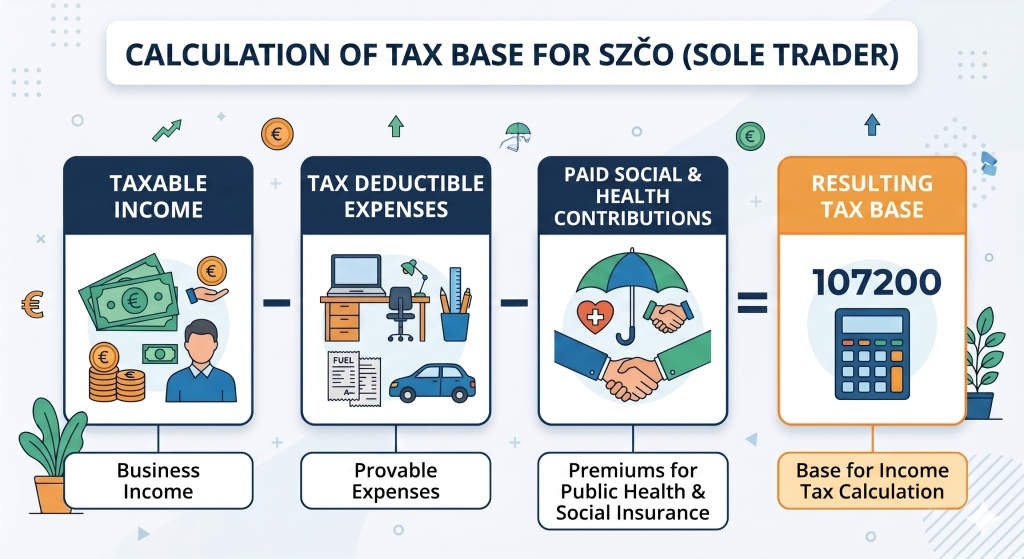
What is the tax base of a self-employed person? The tax base of a self-employed person is legislatively defined as the positive difference between the taxable income of a natural person and the demonstrably incurred tax expenses, reduced by paid contributions. This economic indicator serves as a key variable from which, after deducting the corresponding non-taxable parts, the final sole trader’s profit tax is subsequently calculated.
If a sole trader achieves taxable income, they must strictly monitor their temporal and material relevance to the given tax period. From these gross incomes, the demonstrably paid contributions to the Social and Health Insurance Companies are also deducted. For 100% accurate calculations without penalty risks, it is essential to keep reliable accounting, which reliably guards legislative deadlines and prevents errors.
In practice, it often happens that beginning entrepreneurs confuse the terms turnover and profit. Incomes represent all financial capital that has actually flowed into your accounts, while the sole trader’s profit tax is derived only from the net amount. If you do not systematically record expenses, you run the risk of paying the state much more than is actually necessary.
What tax does a sole trader pay on the income achieved in Slovakia?
What tax does a sole trader pay? The income tax of a sole trader in Slovakia is determined based on a progressive system with three rates: 15% for micro-taxpayers with a
turnover of up to €100,000, 19% up to the set limit, and 25% above this limit. Correct classification of income affects the overall tax burden and requires exact control of legislative limits.
The attractive reduced rate of 15% is applied for so-called Slovak micro-taxpayers, whose net taxable income for one tax period does not exceed the statutory limit of €100,000. Higher earnings are already subject to standard rates of 19% or 25% depending on the exact exceeding of the set multiple of the minimum subsistence level.
Current legal regulations clearly determine these boundaries for tax brackets, which is also confirmed by the Financial Administration of the Slovak Republic. If the annual taxable income of a sole trader exceeds the set statutory limit, then higher progressive taxation is automatically applied to the amount of this excess. Proper classification of income affects the overall income tax of a sole trader, and therefore it is advantageous to leave the agenda, such as complex payroll and contributions, to an external guarantor.
How to reduce the tax base of a self-employed person using flat-rate expenses?
Flat-rate expenses represent a specific legislative optimization tool that allows sole traders to deduct 60% of total taxable income without the need to document actual receipts. The maximum annual financial limit is legally capped at the amount of €20,000, while the paid contributions are also deducted in addition to it.
This administratively undemanding system is extremely popular among entrepreneurs who report minimal actual operating costs, such as IT specialists, consultants, translators, or copywriters. If you decide to apply the flat rate, then in addition to it, you can also deduct demonstrably paid insurance premiums to both insurance companies in the tax return. Our renowned office Lukáčik & Partners will show you how we reliably analyze the profitability of both alternatives.
Applying expenses as a percentage of income simultaneously relieves you of the obligation to keep classic accounting, but you must keep simplified records of income, inventory, and receivables. If you plan to effectively manage your cash flow, this system will provide you with a high degree of predictability.
When are percentage expenses more advantageous than real tax records?
Percentage expenses are financially most advantageous for an entrepreneur if their actual operating costs for business do not reach the limit of 60% of total income or do not exceed the annual cap of €20,000. Otherwise, it is economically necessary to switch to keeping demonstrable tax expenses.
The transition to demonstrable expenses requires consistent and systematic recording of every single tax document. The correct choice of the form of expense records fundamentally determines how to reduce the tax base of a self-employed person with the highest possible financial effect for your business.
If, for example, a craftsman or merchant buys expensive material and their real costs account for 75% of the turnover, applying a flat rate would mean a net financial loss for them. Every entrepreneur should therefore have a comparative calculation prepared before the end of the year.
How to legally optimize the sole trader’s profit tax through demonstrable expenses?
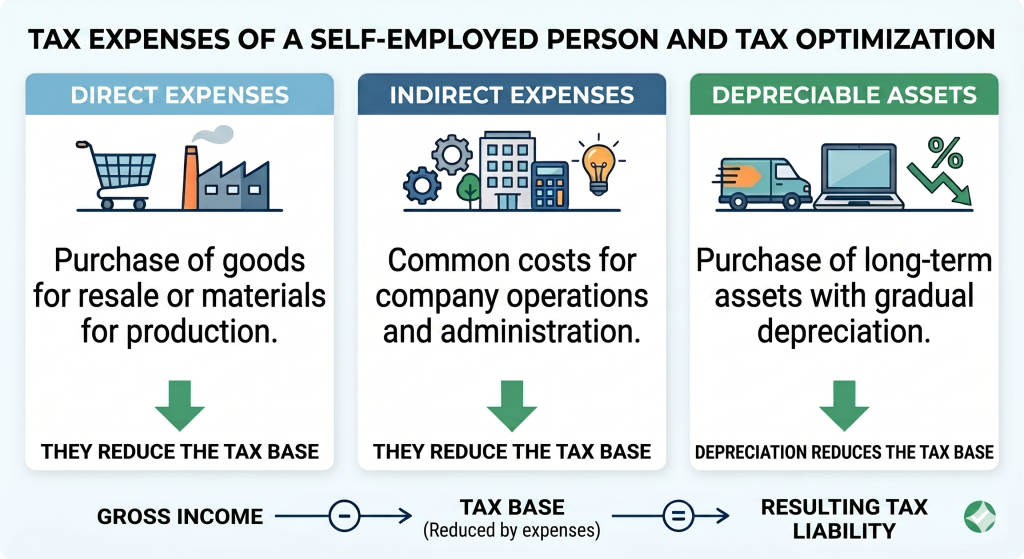
Demonstrable tax expenses are actual financial costs that the entrepreneur has genuinely incurred to achieve, secure, and maintain their taxable income. These costs must be properly recorded in tax records or accounting books, while their correct application minimizes the overall tax base.
Transitioning to real expenses requires keeping accurate tax records. The main categories include depreciation of long-term assets, purchase of material, inventory, renting of premises, or operating overheads. A specific tool for 2026 is the status of a micro-taxpayer, which allows the application of flexible tax depreciation of assets used for business.
A significant component of optimization is a company car. An entrepreneur has the option to choose flat-rate expenses for fuel up to 80% without keeping a logbook, or apply 100% of expenses based on a record of journeys and fuel purchase documents. According to the methodology of the Ministry of Finance of the Slovak Republic, the correct assignment of expenses to a motor vehicle radically affects the annual income tax of a sole trader.
Which items does the Financial Administration of the Slovak Republic most often not recognize as a tax expense?
Non-tax expenses are financial payments that do not meet strict legal conditions of demonstrability, material connection to the business, or are explicitly prohibited by the Income Tax Act. The most risky areas include expenses for personal consumption and unmarked representation costs.
Tax auditors primarily focus on the expenses for personal consumption of the entrepreneur, which are often incorrectly declared as company costs. A typical example is the purchase of clothing that does not have the character of protective clothing, or electronics used by family members. If there is a lack of clear proof of using the assets exclusively for business, then the Financial Administration of the Slovak Republic will apply uncompromising reduction of the expense.
Another risky area is representation costs, which include hosting business partners or gifts without advertising marking. These items are strictly non-taxable according to the Income Tax Act. The following table provides an overview of the most frequently crossed-out items during audits:
| Type of expense in business records | Legislative status of the expense | Main risk during tax audit |
|---|---|---|
| Purchase of personal clothing / suit | Non-tax expense | Automatic non-recognition for personal use |
| Hospitality and lunches with partners | Non-tax expense | Violation of the ban on representation expenses |
| Fuel without receipts | Non-tax expense | Absence of demonstrability and measurability |
| Electronics for family members | Non-tax expense | Reduction of the tax base due to personal consumption |
What non-taxable parts and tax bonuses reduce the income tax of a sole trader?
Non-taxable parts of the tax base are legal deductible items that directly reduce the calculated tax base of a natural person before applying the tax rate. These social and family incentives, together with the tax bonus for a child, represent a highly effective form of reducing the tax liability.
The basic pillar is the non-taxable part for the taxpayer, which every active self-employed person is entitled to, provided their annual tax base of a self-employed person does not exceed the legally defined reduction limit. If the entrepreneur has a wife or husband with their own income lower than what the law dictates, they can also claim the non-taxable part for a spouse. This step leads to effective family tax optimization.
A supplementary, but important tool are contributions to supplementary pension savings (3rd pillar), which can be deducted up to a limit of €180 annually. After calculating the tax itself, the tax bonus for a child comes into play, which does not take the form of reducing the tax base, but a direct deduction from the resulting tax liability. If a sole trader reports sufficient taxable income, the state will pay them the full bonus amount according to the child’s age.
Why is the transformation into an s.r.o. (LLC) an effective way to reduce the tax burden?
The transformation of a sole proprietorship into a limited liability company (s.r.o.) is an organizational change that allows reducing the tax burden by moving high profits into a corporate structure with an advantageous tax rate. This step eliminates the payment of high contributions to the Social Insurance Agency from the achieved company profit.
If the sole trader’s profit tax reaches a level where it is subject to the progressive rate of 25% and maximum contributions to the Social Insurance Agency, then the change of legal form becomes a financial priority. A capital company does not pay contributions from the achieved profit, but exclusively from the actually paid salary of the employed managing director or in the form of dividends, which are subject to a different tax regime.
This strategic step effectively protects the entrepreneur’s personal property and simultaneously opens wide possibilities for advanced tax planning. According to long-term calculations, the breaking point for the transition is an annual net profit of over 25,000 to 30,000 euros. A legal entity can combine the advantageous 10% tax for an s.r.o. with a controlled redistribution of corporate capital.
Why is year-round tax planning the key to minimizing taxes?
Year-round tax planning is a continuous process of ongoing monitoring of economic indicators, which allows legal optimization tools to be deployed in time before the end of the tax period. It helps prevent inefficient spending of capital in a time crunch at the end of the calendar year.
If a self-employed person only begins to address the question of how to reduce the tax base of a self-employed person during the filing of the tax return in March, then they lose most legal possibilities for applying tax benefits. Close cooperation with experts in tax advisory makes it possible to react in time to legislative changes and correctly allocate available financial resources into business development.
Key year-round steps that favorably affect the income tax of a sole trader include these measures:
- Continuous comparison of the actual profitability between flat-rate expenses and keeping tax records.
- Timely purchase of long-term tangible assets using accelerated or variable tax depreciation.
- Legal creation of accounting reserves for expected risks, future liabilities, or contractual penalties of partners.
- Consistent control of turnover limits to maintain the advantageous status of a micro-taxpayer.
Frequently asked questions about the optimization of SZČO taxes (FAQ)
Can a self-employed person claim flat-rate expenses if they are a VAT payer?
A sole trader who is registered as a VAT payer for the entire taxable period cannot claim lump-sum expenses. However, if an entrepreneur is registered as a VAT payer for only part of the calendar year, they can still claim lump-sum expenses in that case.
How does the suspension of a trade affect the calculation of profit tax?
Suspension of a trade is a temporary halt of business activity, which imposes a legal obligation to adjust the tax base of a self-employed person by the balance of unconsumed inventory, unpaid invoices, and unsettled liabilities as of the date of suspension. If a sole trader does not resume business by the date of filing the tax return, then they must mandatorily tax these items additionally.
What are the risks for a sole trader for incorrectly reported income tax?
Incorrectly calculated tax threatens high financial penalties and default interest, which the tax administrator calculates from the amount of reduced tax for each calendar day of the duration of the unlawful state. If a taxpayer discovers an error through their own control, then they should immediately file an additional tax return, which legislatively minimizes the total amount of the imposed fine.