Managing the financial structure in a capital company with a single shareholder requires a strict separation of personal and corporate finances. When analyzing single-member s.r.o. expenses, the key to maximizing net profit is the precise identification of tax-deductible expenses. Efficient tax management eliminates risks associated with audits by the Financial Administration of the Slovak Republic. To achieve an optimal setup, it is essential to implement professional accounting, which transforms administrative duties into a strategic tool for cash-flow management.

What constitutes tax-deductible expenses of a single-member s.r.o.?
Tax-deductible expenses of a single-member s.r.o. are demonstrably incurred expenditures for achieving, securing, and maintaining taxable income, which are properly recorded in accordance with the Income Tax Act. These expenses reduce the corporate income tax base, and their material connection to the business must be defensible before the tax administrator at any time.
In the practice of a single-member company, there is a frequent overlapping of personal needs and business activities. According to Section 19 of Act No. 595/2003 Coll. on Income Tax, if an expense does not have a direct causal relationship with the corporation’s economic activity, the tax administrator will uncompromisingly exclude it during an audit. The statutory representative must therefore assign an unquestionable argument and a supporting document to every accounting entry.
Which expenses of the founder before the company’s incorporation are tax-deductible?
Expenses before the incorporation of the company are setup costs incurred by the founder during the period from the approval of the deed of establishment until the day of the official registration of the entity in the Commercial Register. These include fees for notary verification of signatures, court fees, or consulting services.
According to the Commercial Code, the founder acts on behalf of the company before its incorporation. If these expenses are directly related to the establishment and are legislatively specified, the s.r.o. will record them as an expense or as incorporation costs after its establishment.
How to correctly account for a car, phone, and home office in a single-member company?
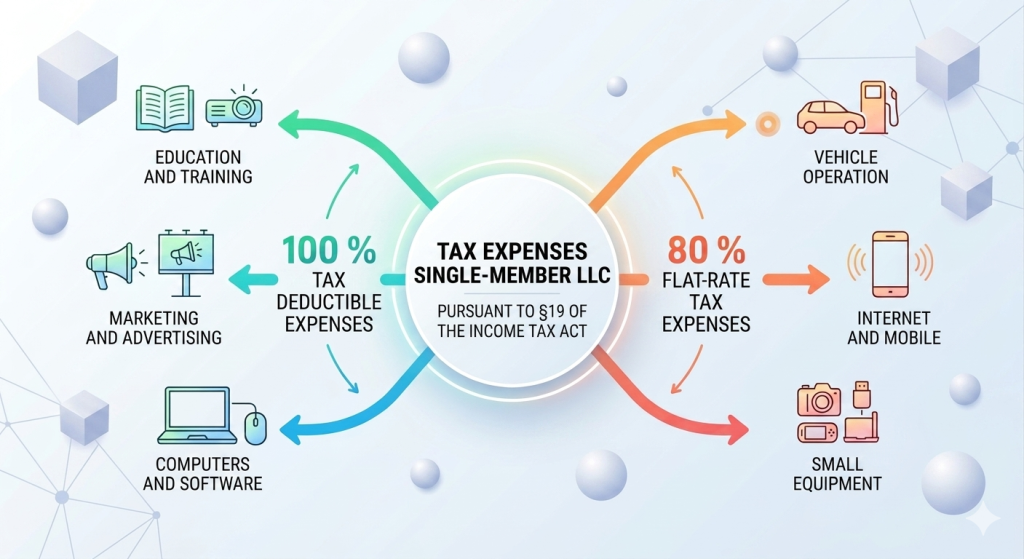
Accounting for assets used for both personal and business purposes is governed by the principle of expense reduction, where the law allows for a lump-sum tax expense deduction of 80%. If the company proves 100% utilization of the asset for business through internal records, then the full amount of expenses can be included in the tax-deductible costs.
For motor vehicles included in business assets, the executive applies either a logbook or an 80% lump sum for fuel purchases. In the case of a home office, the situation is more complex. The company cannot automatically claim housing costs without a proper lease agreement, while transfer pricing rules must also be respected.
What are the real operational expenses of a single-member s.r.o. in 2026?
Real operational expenses of a single-member s.r.o. in 2026 represent the sum of fixed and variable expenditures necessary for the legislative maintenance of the corporate identity and the fulfillment of tax obligations. These costs include bank account fees, software licenses, mandatory tax prepayments, and professional external advisory services.
How much does legislatively mandatory double-entry bookkeeping and payroll management cost?
The costs of accounting administration represent an investment in legislative compliance and protection against sanctions. For a single-member company, professional double-entry bookkeeping ensures accurate records of assets, liabilities, and economic results.
The price range in 2026 depends on the selected package and the overall document structure. If the company has employees, even if only the executive under an agreement on the performance of a function, payroll management increases fixed expenses due to fees for processing reports for the Social and Health Insurance companies.
What are the minimum contributions and taxes for a single shareholder and executive?
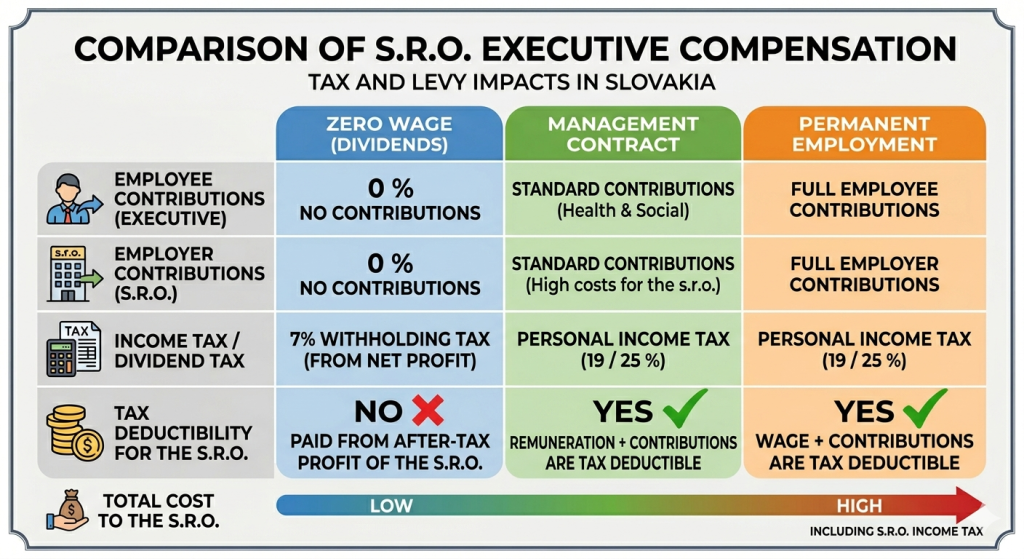
The minimum contributions and taxes of a single-member s.r.o. are not legislatively set at a fixed sum but depend on the chosen remuneration model for the statutory representative. If the executive does not perform the function based on remuneration, the company pays no monthly social or health insurance contributions.
In such a case, the company’s profit is taxed with corporate income tax. After taxation, the net profit is distributed to the shareholder in the form of dividends, which are subject to withholding tax. If the executive decides on an employment relationship, then the company must bear the insurance contribution burden, which constitutes a fully tax-deductible expense.
What mistakes do entrepreneurs make when assessing the expenses of a single-member s.r.o.?
The most common mistakes when assessing company expenses stem from a misunderstanding of asset separation and a lack of expenditure support. If the statutory representative mixes personal needs with business assets, they risk additional tax assessments and sanctions.
Single-member s.r.o.s often face audits due to unauthorized VAT deductions on personal consumption goods. Transactions between the shareholder and the firm must be supported by transfer pricing documentation and market prices. Ignoring these rules leads to the reclassification of payments as hidden profit distribution.
When will the Financial Administration reject personal consumption as a company expense?
The Financial Administration will not recognize personal consumption if the taxpayer fails to demonstrate a direct material and temporal connection between the expense and the achieved revenue. Typical examples include clothing purchases or fictitious travel allowances without proper records of a business trip.
According to methodological guidelines, the burden of proof lies fully on the shoulders of the tax subject. If there is no internal directive or contractual documentation confirming the use of the asset for business, the tax administrator will uncompromisingly exclude the expenditure.
How to correctly report costs for cryptocurrencies and digital tools?
Correct reporting of costs for digital assets requires their valuation at fair value at the moment of acquisition and disposal. Operations with cryptocurrencies are subject to specific rules for exchange rate conversions and deferrals.
Investments in cryptocurrencies must not be depreciated as standard assets in the double-entry system. Cloud infrastructure costs must be deferred according to the period of their actual use.
Is it more advantageous to manage company finances self-sufficiently or via outsourcing?
External outsourcing of company finances is economically and legally more advantageous for a single-member s.r.o. A professional company assumes full contractual liability for damages and eliminates fixed software costs.
Self-managing bookkeeping exposes the company to the risk of incorrect interpretation of legislation. A specialized company carries professional indemnity insurance, which represents the elimination of operational risk for a single-member entity.
How does legal tax optimization reduce the overall cost of a corporation?
Legal tax optimization reduces the overall cost of an s.r.o. through strategic expense planning. It allows for a legal reduction of the income tax base before the end of the tax period without weakening liquidity.
Effective setup of depreciation schedules, creation of statutory reserves, and utilization of deferrals are among the basic tools. This process requires continuous cooperation with experts.
Frequently Asked Questions about costs in a single-member s.r.o. (FAQ)
Can a single-member s.r.o. operate with zero monthly costs?
No, a single-member s.r.o. cannot operate with absolutely zero costs. It must bear minimum fixed expenses such as corporate bank account fees or electronic communication.
How does an s.r.o. executive legally pay themselves money with the lowest tax burden?
The most effective way to transfer funds is the payment of shares in profit (dividends). Dividends are subject to withholding tax but are exempt from contributions to the Social Insurance Agency. In practice, a combination of a minimum reward with annual distribution of net profit is used.
What happens if tax expenses long-term exceed the company’s revenues?
A long-term tax loss represents a serious legal risk. If equity drops below half of the registered capital, the company is considered to be in crisis. The statutory representative is obliged to take corrective measures without delay.