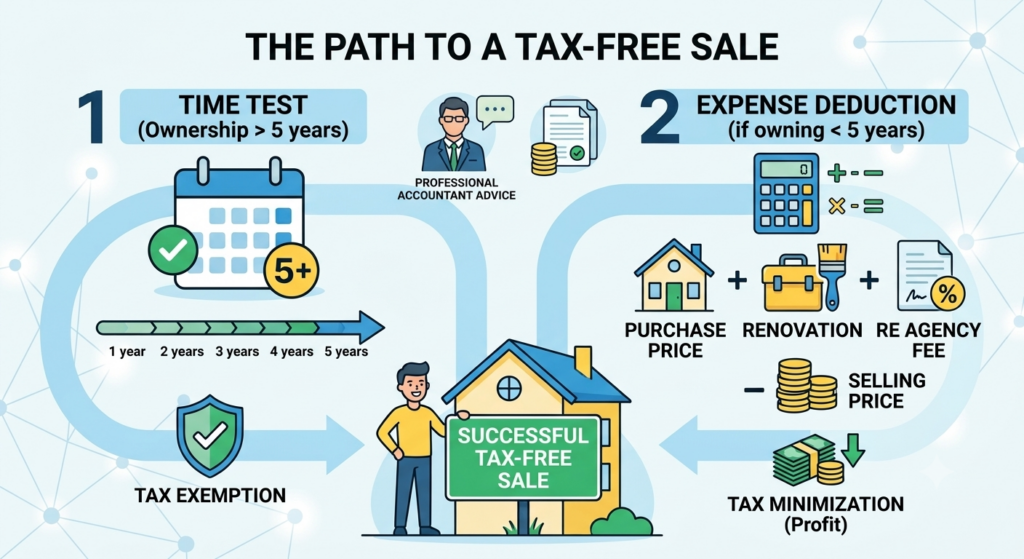
Selling an apartment does not automatically trigger an obligation to pay income tax. The Slovak Income Tax Act offers several legal ways to avoid the tax completely or reduce it significantly. The main mechanisms include meeting the ownership time test and correctly including demonstrable expenses – each of them can save you thousands of euros. For flawless expense tracking, in addition to expert assessment, properly managed accounting and professional accounting consultation are essential – they will help you correctly categorize and document every expense.
In this article, we will analyze individual solutions in detail and point out the errors that people make most frequently when providing documentation. If you are unsure about your case, we recommend tax advisory from specialists. They will evaluate your specific scenario and prepare you for potential communication with the tax administrator.
When Do You Pay Tax on the Sale of an Apartment at All?
Income tax on the sale of an apartment is paid when the income is not exempt and at the same time exceeds demonstrable expenses. The legal framework consists of Sections 8 and 9 of Act No. 595/2003 Coll. on Income Tax, as amended. Income from the transfer of real estate ownership is considered other income, which is subject to a progressive personal income tax rate of 19% (on the part of the tax base that does not exceed the legally established threshold) or 25% (on the amount above this threshold). In addition, health insurance contributions of 15% must be added to the resulting tax, which also result from the sale of real estate.
Two variables are decisive: the duration of ownership and the amount of net income after deducting costs. If you owned the apartment for a shorter period than required by the legal time test of 5 years, you must file a tax return and tax the net profit – unless you meet one of the narrow legal exceptions.
How Does the Sale of an Apartment Differ from the Sale of Other Property?
The law strictly distinguishes between income from the sale of real estate and income from the sale of ordinary movable property. While a strict five-year time test applies to an apartment, for movable property (unless included in business assets), the income is exempt from tax automatically and without time restrictions.
Moreover, if you used the property for business in the past or recorded it as business assets, you lose the exemption after 5 years from acquisition. In such a case, the five-year exemption period begins to run anew only from the moment the property is excluded from business assets. In these situations, thorough accounting records of the entire asset history are necessary, which reliable accounting consultation can help you with.
How Do Tax Exemptions Work When Selling Real Estate?
The most frequently used route is owning the property for longer than the five-year time test specifies under Section 9, Paragraph 1, Letter a) of the Income Tax Act. Other legitimate reasons for exemption include acquiring real estate by inheritance in a direct line (after parents, grandparents, or children) or after a deceased spouse, or the return of property under restitutions.
The Financial Administration of the SR emphasizes that the exemption applies exclusively to natural persons who did not have the property included in business assets (or have already met 5 years since its exclusion). Always check carefully whether you meet all legal conditions – a clearly documented asset history significantly reduces the risk of disputes with the tax office.
What Exactly Does the Time Test Mean?
The time test period lasts exactly 5 years (60 months) and its progression begins depending on the method of property acquisition:
- In the case of a classic purchase: The decisive factor is the day the ownership right is entered into the real estate cadastre (the day the entry is approved), not the signing of the purchase contract.
- In the case of inheritance in a direct line: The period is assessed from the day of the testator’s death, and the time during which the deceased relative demonstrably owned the property is also counted towards it.
- In the case of restitution: The day the decision on the return of property becomes legally effective is decisive.
The period during which the real estate was part of the business assets of a company or a sole proprietorship is not included in the progression of the period. If you owned the apartment for at least one day longer than the legal limit of five years, you do not pay income tax or contributions – and you do not even have to report the sale to the tax administrator.
Beware of a Frequent Myth: Exemption for Investing in New Housing Does Not Apply Here
There is a frequent rumor among the Slovak public that if you use the money from the sale of an apartment to satisfy your own housing needs (e.g., buying a new house or apartment), you do not have to pay tax. This is a dangerous myth. In the Slovak Income Tax Act, such an exception for natural persons does not exist (it is a confusion with Czech legislation). If you sell a property before 5 years have elapsed since its acquisition, you must declare and tax the profit regardless of whether you plan to buy another home with the money received or spend it in another way.
How to Reduce Your Tax Base and Avoid Paying
If you do not meet the conditions for full exemption, your only legal option is to minimize the tax base through the thorough application of demonstrable expenses. A simple formula applies:
Tax base = Selling price – Purchase price – Other recognized expenses
Only the net positive difference (profit) is taxed. If you sell the apartment for the same price you bought it for, or if you report a loss after factoring in a renovation, the resulting tax will be zero. However, you must file a tax return in such a case. All expenses must be 100% defensible and properly documented with an invoice, contract, or cash receipt. It is precisely during documentation that sellers make the most mistakes.
Which Expenses Can You Deduct?
All costs directly related to the acquisition, sale, or technical appreciation of the apartment are recognized.
|
Expense |
Required Document |
Note |
|---|---|---|
|
Purchase price of the apartment |
Purchase contract, cadastre extract |
The amount agreed upon in the contract, not the expert appraisal value at the time of sale. |
|
Mortgage loan interest |
Loan account statements, bank confirmation |
You can only deduct demonstrably paid interest and loan fees, not the principal repayments themselves. |
|
Renovation and modernization |
Invoices from suppliers, material receipts |
These must be structural alterations that appreciate the property (replacement of windows, floors, wiring), not ordinary minor maintenance. |
|
Project documentation and supervision |
Contract, invoice |
Recognized for more extensive construction interventions requiring permits. |
|
Real estate agency commission |
Brokerage contract, invoice |
Accepted in full if it was actually paid for the sale of the property. |
|
|
Why Document Tracking Is Crucial and How e-Invoice with AI Reading Helps You
Without physical or indisputable digital documents, the tax office will not recognize any expenses. The most common mistake is that people lose receipts for purchasing construction materials over the years or do not have an official invoice from craftsmen.
The solution is continuous filing of documents. Tools like e-invoice with AI document reading can automatically extract key data from a photo of a receipt or a PDF invoice, sort them into categories (material, services, fees), and assign them to the relevant tax period. These modern applications will create a reliable, legally acceptable digital archive for you, which you can easily export with one click in the event of a tax audit.
Most Common Mistakes in Documentation and How to Prevent Them
Missing invoices, incomplete contracts, and incorrect classification of expenses are the main reasons why sellers pay a higher tax to the state than they actually have to. Income from the sale of real estate belongs to the areas that tax offices focus on very often. If you do not prove the legitimacy of the cost, the tax administrator will uncompromisingly exclude it and retroactively assess tax, contributions, and penalty interest.
How to Prepare Documents for a Tax Audit
- Thoroughly check invoice requirements: Every document for material or renovation must contain your full name, address, exact subject of performance, amount, and date. The office will not recognize anonymous receipts beyond an ordinary purchase.
- Prefer non-cash payments: A bank statement is irreversible proof that the transaction actually took place. Furthermore, according to the Act on the Limitation of Cash Payments, a strict limit of €5,000 applies in Slovakia – any payments above this value are prohibited in cash and must be made exclusively via bank transfer.
- Archive dually: Scanned documents in a secure cloud protect you from thermal paper fading or physical destruction of receipts. The use of smart AI applications ensures a legally recognizable electronic copy for you.
- Break down expenses by year: If you improved the property gradually, assign each cost to the year in which it was actually paid, which will speed up the course of a potential multi-year audit.
Frequently Asked Questions (FAQ)
Do I have to pay tax if I sell a gifted apartment?
Yes, the obligation arises if you sell it before 5 years have elapsed from the moment you acquired it. In the case of a gift, the time test period begins to count exactly from the day the cadastre approved the entry of ownership rights in your favor as the donee.
What if I inherited the apartment from my parents?
In the case of inheritance in a direct line (after parents, grandparents) or after a spouse, an advantage applies: the period of ownership of the testator (the deceased) is also counted towards the 5 years of the time test. If, for example, your father owned the apartment for 4 years, you inherited it, and you sell it after one year of ownership, the 5-year condition is met and you do not pay tax.
Can the tax be avoided by selling a co-ownership share?
No. When selling a co-ownership share, exactly the same rules apply as when selling the entire property. However, the time test is assessed for each share separately. If you owned half of the apartment for 6 years and bought the second half from a sibling two years ago, only that part of the income that belongs to the first share is exempt from tax.
What tax will I pay if I sell a new building bought two years ago?
Since you do not meet the five-year limit, you will tax the positive difference between the selling price and demonstrable costs (purchase price, loan interest, real estate agency fees, potential interior finishing). The net profit will be subject to a personal income tax rate (19% or 25%) and 15% health insurance contributions.
What if I want to sell an apartment and immediately buy a cheaper one – does the exemption apply to me?
No, Slovak legislation does not know any exemption based on reinvesting money into new housing. The fact that you immediately use the money to buy another property has no influence on your tax liability. The only deciding factor is whether the apartment being sold meets the five-year ownership period.
Can I also deduct the costs of furnishing the apartment from taxes?
No, ordinary interior equipment (freestanding furniture, washing machine, refrigerator, decorations) is not considered technical appreciation or a structural modification of the real estate. You can only deduct fixed interventions into the building – new plastering, windows, floors, utility distribution lines, sanitary ware, or custom-made built-in wardrobes and a kitchen unit, which are firmly connected to the structure of the apartment.
Conclusion
Selling an apartment and not paying tax is absolutely realistic, but it requires the consistent use of legal options – primarily adhering to the five-year time test or precisely clearing the income of demonstrable expenses. The key to success is systematic and timely tracking of all documents. Whether you decide to use one-time tax advisory or modern technologies for complete accounting management, having a reliable partner for accounting consultation by your side to watch deadlines and check invoice requirements for you always pays off financially.